the unconscious and THE Unconscious

In a recent discussion of psychoanalysis, several commenters questioned the relationship between the empirically-supported unconscious and THE Unconscious of psychoanalytic theory. There is empirical support for the unconscious as a loosely-structured amalgam of neural nodes and connections, of memories and fragmented thoughts, waiting to be assembled into meaningful combinations by consciousness. But is there a place in the mind where hidden truths reside, a structure or process or event that speaks to consciousness with the intent of breaking through and revealing its secrets — THE Unconscious, if you will?

I don’t think so. In my view, the “breakthroughs” of analysis can be accounted for by the workings of the unconscious with a small “u,” without invoking this other repository of truth,  intentional revealer to consciousness, and portal to the Real that constitutes THE Unconscious.

In an earlier post (2½ years ago today!) I outlined Donnel Stern’s description of the unconscious. Stern, a psychoanalyst, offers an interpretation that aligns quite well with contemporary empirical psychology. The unconscious is structured like a language, Lacan famously pronounced, and in a sense that’s how the brain’s interconnections work. Language isn’t organized into prestored sentences that people retrieve as needed. Rather, the vocabulary and rules of language are only loosely organized, available as materials from which language-users can construct sentences on the fly. Brains are structured in this way too. Ideas, memories, and other stuff in the brain are widely but loosely connected to each other, available for retrieval when we need to solve a problem, remember how to get to Joe’s house, or talk about the weather.

Through repetition, certain interconnections become stronger than others — these are the ones most readily accessible to consciousness. But other connections are there too, operating below the threshold of consciousness. These weaker connections are usually overpowered by the stronger ones. This sort of “repression” may result from active effort to prevent certain neural connections from surfacing. More often, the weaker connections just never reach the synaptic “tipping point” which brings them across the threshold into conscious awareness.

In the psychoanalytic encounter, the analyst encourages the analysand to loosen up the dominant, habitual mental connections — to “deterritorialize” the mind, using Deleuze and Guattari’s terminology. By drawing attention to slips of the tongue, metaphors, and dual meanings, the analyst pulls on those secondary neural connections between words and ideas in hopes of bringing them into consciousness. Exploring these alternative ways of organizing mental material may lead the analysand into formulating new insights about past and present experiences and ascribing different meanings to them.

Stern explicitly draws the implications for THE Unconscious of traditional psychoanalytic theory:

“If unconscious experience does not have a single, predetermined meaning, but remains to be interpreted in reflective awareness, the effect of clinical interpretation does not depend on objective accuracy and cannot be judged on that basis.” (p. 63)

It’s difficult if not impossible to verify the supposed truth claims revealed by probing the unconscious, as testified by the recent resurgence and critique of repressed childhood memories retrieved through hypnosis and such as the cause of psychological disorders. Even Freud didn’t believe that these retrieved memories were “true” objectively; rather, he thought they constituted projections and wishes. Stern contends that bringing unconscious material into consciousness usually entails reformulating the meaning of memories that are already accessible to consciousness rather than uncovering previously repressed memories.

Stern continues:

“If unconscious meaning is an objective fact, and the clinical function of language is to label it, then the purpose of interpretation is the accurate matching of facts and labels. The only interpretations we can possibly make of objectively existing unconscious content must be — like their objects — objective, scientific, and nonphenomenological. Under these conditions, the analyst would be expected to explain the patient’s conduct and experience on the basis of nonintrospectible, but theoretically conceivable, abs0lute unconscious phenomena. The analyst would then be expected to convey these explanations to the patient in the form of objectively accurate interpretations.” (p. 164)

Stern doesn’t believe that analysis produces this unveiling of objective truths hidden in the unconscious. (It should be noted that none of what Stern says here would change if the patient rather than the analyst were doing the interpretations.) What is the alternative?

“Psychoanalysts and analysands do judge the goodness of their interpretations, of course. They do that continuously. But the accuracy of our portrayals of unconscious meaning is virtually irrelevant as a truth criterion. ‘Accuracy’ is not really even a meaningful term in discussing the interpretation of unformulated experience, because the term cannot be defined by reference to an observable relation between itself and its object. We know the object (to repeat the essential point) only by means of our interpretation of it. That means clinical interpretation is not objective and scientific, but subjective and phenomenological. And it spells the end of correspondence theory in psychoanalysis. We can no longer hold that the nonverbal unconscious meaning is the ‘real’ one that our words simply clothe or represent, or to which they correspond.” (p. 165)

Stern insists that it’s not necessary to deny the existence of a structured reality outside of awareness or language. He’s only contending that the meaning of the real isn’t fixed, either in the world or in the unconscious mind, waiting to be discovered. In psychoanalysis, interpretation leads to the conscious construction of meanings on material that had previously either been locked into an inadequate meaning or had remained unformulated, uninterpreted, personally meaningless.

“Interpretation has an organizing function. It is not a set of correct labels, but a redescription of the patient’s experience at a level of differentiation and articulation higher than the patient had heretofore reached. In this process of redescribing, an interpretation may bring together pieces of experience, or even of logic or emotional argumentation, that have never before appeared in the patient’s mind in a single configuration. An interpretation is a new Gestalt.” (p. 171)

Quiddity

Marco Polo describes a bridge, stone by stone.

“But which is the stone that supports the bridge?” Kublai Khan asks.

“The bridge is not supported by one stone or another,” Marco answers, “but by the line of the arch that they form.”

Kublai Khan remains silent, reflecting. Then he adds: “Why do you speak to me of the stones? It is only the arch that matters to me.”

Polo answers: “Without stones there is no arch.”

– from Invisible Cities by Italo Calvino, 1972

Speculations Yes

Just to add my two cents, I’m in full support of Speculations, the new online, open-access journal that Paul Ennis of Anotherheideggerblog is making happen. It would be perfectly great if the entire editorial board and most of the contributors are grad students and unaffiliated scholars, inasmuch they almost surely know more about object-oriented philosophy than do most of the philosophy faculty. I think it’s also a strong and generous act of support that Graham Harman and Levi Bryant will be contributing papers outlining the theoretical issues.

Fabio at hyper tiling opined recently that he tends to lose focus on blog posts exceeding a thousand words. Me too. Journal articles are a different sort of writing, calling for a different sort of reading. Why wait for the authorities to put their imprimatur on a field of study or a publication, or even an author? DIY.

Is Psychoanalysis Empirically Supported?

In a recent discussion at Perverse Egalitarianism regarding the relationship between ontology and politics, Asher Kay went off-topic to question the empirical validity of psychoanalysis. Asher had a book in hand casting strong doubt on the empirical basis for analysis. Bryan Klausmeyer countered by saying that clearly the unconscious exists, just as analysis asserts. Levi Bryant contended that the empirical support for psychoanalysis comes from clinical practice. Here’s my view of the situation, which I previously relayed to a few people via email.

There’s strong empirical support for the existence of the unconscious. This evidence isn’t generated only by analysts either. Social psychologists devise all sort of ingenious experiments for exploring ways in which our minds play tricks on us, where what people consciously say and believe are at odds with what they do and decide. Cognitive psychologists design problems intended to expose cognitive processes and intermediate results that happen in brains beneath the threshold of conscious awareness. Neuroscientists look at brain structures and functions that operate far beneath consciousness. Consciousness is just the tip of the iceberg of brain/mind activity, which is evident to all of us. E.g., what will I write in my next sentence? I don’t know yet: I’ll assemble it from components of knowledge and language that’s distributed in my brain but that I’m not consciously rehearsing. What was the name of my next door neighbor’s dog while I was growing up? I know it, but I have to retrieve it from unconscious memory in order to answer the question. As I wrote in a post a couple of months ago:

“Based on a count of receptor cells and their neural connections, neuroscientists estimate that the human sensory system takes in more than 11 million pieces of information per second. Based on studies of processing speed on tasks like reading and detecting different flashes of light, cognitive psychologists estimate that people can process consciously about 40 pieces of information per second. What happens to the other 10,999,960? It’s processed unconsciously.”

Is there empirical support for the metapsychology of psychoanalysis? Here I’m referring to things like the id/ego/superego distinction, the Oedipus complex, the oral/anal/genital/phallic stages of development, the divided self centered around lack, the imaginary/symbolic/real, the unsatisfiability of desire, and so on? I’ve not read A Final Accounting, the book Asher cited, but I’d agree with the author’s general conclusion that the evidence is either weak or nonexistent. For what it’s worth, psychoanalytic theory plays virtually no role in contemporary empirical psychology and its investigations of cognition, memory, the unconscious, personality, and even psychopathology. Awhile back I wrote a post critiquing Lacan’s supposed empirical support for a “mirror stage” preceding language acquisition leading to the development of the “specular image” of the self. This situation follows what seems to be the typical pattern: despite claims to evidentiary support for the theories, the evidence typically doesn’t hold up to closer scrutiny.

Regarding the therapeutic outcomes of psychoanalysis… I know, I know, analysis isn’t therapy. However, people tend to be motivated to come for analysis because they’re suffering from symptoms, and I daresay that they expect analysis to alleviate their suffering. Many empirical studies point to the same conclusion: pretty much any therapeutic intervention is far better than no intervention, but no particular technique seems to work any better than the rest. Also, the amount of experience on the therapist’s part seems to have no impact on outcome.

One implication of this finding of similar results across modalities is that all modalities achieve their effects pretty much the same same way. So even though psychoanalysis and cognitive behavioral therapy espouse different praxes and theoretical rationales, they might be wrong regarding the cause-effect connection. It seems likely that establishing and maintaining a supportive relationship between therapist and client is the most important criterion for obtaining good symptom relief.

It should be noted that cognitive behavioral therapy gains no greater empirical support for therapeutic outcomes than does psychoanalysis. The constructs of CBT seem fairly common-sensical, even managerial, which suits some people better than does the quasi-mystical language of analytic theory. And there is some empirical evidence that people who believe in the particular treatment praxis they receive are more likely to benefit from therapy.

*   *   *

Though I’m not persuaded by the empirical evidence supporting psychoanalysis, I find it more fascinating than ever. Empiricism in psychological research is mostly a matter of averages. But it’s a pretty squishy field of research, with even strong correlations between variables typically overwhelmed by the statistical variation. Clinical practice opens up the exploration of the variations, the individual differences that get lost in empirical averaging. Two people scoring the same on a depression inventory can have very different subjective experiences of their depression, different causal trajectories, different ways in which their symptom affects their lives, and so on.

I found as a therapist that the empirical evidence had very little to do with the way I engaged with clients, because for the individual it’s the unique trajectory through life that’s important. At the same time, I have to acknowledge that after seeing multiple clients I found them all blurring together into something like an average client. Some therapists probably find that comforting: I know what to do with this case. My reaction was that I began losing interest, feeling unengaged and mechanical and distant in dealing with the clients. That’s why I quit doing therapy.

To illustrate the value of psychoanalysis, Levi Bryant described on Larval Subjects his experience of repeatedly breaking the chalk on the blackboard when he was a new teacher. His analyst’s intervention was to repeat a phrase that Levi spoke during a session, something about “pressure on the board.” The analyst’s restating of Levi’s remark triggered a cascade of insights, and shortly thereafter the chalk-breaking stopped.

What’s the common-sense response to this example? You’re tense. It’s natural to be nervous when you start out doing anything; most people fear public speaking; give it some time and you’ll start relaxing. And in most instances the common-sense response would be accurate: the nervousness would abate in time, the new teacher would stop pressing (literally and figuratively) so hard and relax into a comfort zone. One could imagine different sorts of interventions for accelerating the process. Relaxation exercises. Systematic desensitization — think about the chalk, pick it up and set it back down, pick it up and press it on the board and set it down, etc. CBT — it’s irrational to think that you’re less competent than your students, or that they care more about your performance than about their own grade in the class; become aware of your bodily and mental sensations leading up to the chalk-breaking and try to short-circuit the event by taking a deep breath and relaxing the hand holding the chalk; etc. We could even imagine a Freudian drawing analogies between the piece of chalk and the penis, handling the chalk and masturbation, breaking the chalk and self-castration for trying to take the place of the father in the classroom, and so on. Every one of these specific interventions might be useless in causing new teachers to stop breaking chalk, but the chalk-breaking would probably stop anyway over time. In all likelihood, though, Levi would attribute his lighter touch with the chalk to whatever sort of intervention technique he happened to undergo. And empirically speaking, just having someone there to support him would likely have reduced Levi’s anxiety more quickly than if he’d just dealt with it on his own.

But Levi’s analyst encouraged him to deal with the chalk-breaking symptom not just as something to overcome but as a sort of exploratory window. Looking through the window, Levi was able to see various ways in which this chalk-breaking symptom might relate to other experiences in his life, other symptoms, past experiences that caused similar reactions. The loosening of rational conscious thought encouraged by the psychoanalytic context opened up the window even wider, bringing in less obvious, less well-rehearsed interconnections in memory and affect. The analyst’s interventions serve not to foreclose further exploration through expert judgment but to loosen the strictures even further, to deterritorialize the neural net with little schizzy interruptions in the usual flow of associations. Levi might have stopped breaking chalks at about the same time if he’d gone for CBT instead, but almost certainly he wouldn’t have had as rich and unique an experience along the way.

To me this is the great thing about psychoanalytic praxis: it regards symptoms as opportunities to open up windows rather than as cracks in the walls that have to be patched up. The kinds of discoveries a client might make are liable to be some combination of the ordinary and the idiosyncratic, just like all human experience tends to be. But for that particular client the discoveries add depth and texture and meaning to life. In this sense analysis is more like watching a great movie, or perhaps like writing a novel, than like going to a repair shop. What are the measurable outcomes of reading Crime and Punishment? You might pass a knowledge test, you might write a good interpretive essay, but ultimately it’s some sort of (trans)formative experience that contributes something intangible and distinct to who you are and how you experience the world.

*   *   *

Is psychoanalysis worth the money? I suppose the question is: compared to what? It seems self-indulgent, but so is buying a new car every few years or remodeling the kitchen. Those shopping-cart comparisons point to something fairly obvious: it’s hard not to think of analysis as a bourgeois luxury good. And yet, even in the go-go borrow-and-spend years leading up to the latest meltdown, those who could afford analysis rarely made that purchase. Is it because of the lack of empirical support? Doubtful. After all, consumers know that a new car loses a few thousand dollars in value the minute you drive it off the lot. There’s just something sort of decadently impractical about analysis. Besides, who intentionally wants to pick at the scabs of old wounds and open up cans of worms?

Stepping Onto the Pier

No, I’ve still not embarked on my month-long novel-writing project. But I am getting closer to the water.

I suppose I’ve got writer’s block, brought on and exacerbated by a variety of factors that those of you who’ve followed my blog for awhile can probably identify. NaNoWriMo is a gimmick to be sure. For procrastinators the deadline helps, and the virtual community of fellow Nanoistes provides further impetus. I was hoping that it might simulate an external call for the writing, a call that would stimulate my desire actually to set sail again into the fictional waters. Mostly though, NaNoWriMo is provoking me to come to grips with what sort of fiction I write, could write, would like to write.

The sheer speed demanded by the proposed voyage — 50 thousand words in a month = 1667 per day — initially suggested a free-write, stream-of-consciousness approach. Just let it rip, I tried to persuade myself: don’t think about it; just do it. But 1667 words really isn’t that much — I’ve written fiction that quickly before in stretches, when I was on my game. So then I thought about doing each daily installment in an hour, forcing myself to write as if I were free-associating on the analyst’s couch. I do think that would be fun, and I still might do it.

But yesterday and this morning I’ve felt myself drawn back again to the kind of writing, and the kind of book, that I’ve done before. I’ve long considered undertaking a sequel of sorts to the first novel I wrote, which I sometimes think of as Philip Marlowe trying to unravel a Borgesian mystery only to find himself entangled in the case. But the more I thought and wrote about the sequel the longer and more complicated it became, so I abandoned it. Now though, forced to confine myself to a 50 thousand word limit, I’ve watched one piece of that vast sequel slowly rising to the surface. So I think I might hop aboard that plank and assemble a boat out there on the November seas.

On my morning walk I was trying to decide where the new story should be set and who the Philip Marlowe character should be this time. My thoughts took me back to my second book, which ends by introducing a character who might fill that role. But why should I link the third novel to the second when I’m intending to follow on from the first one? And then I realized something else: omens typically have to fall right on my head before I recognize them.

Yesterday afternoon I was walking along one of my usual routes, preoccupied with this NaNoWriMo thing, when something out of place caught my attention. I looked closer: there, perched in the crook of a tree, sat an espresso machine, its cord dangling halfway to the ground. I inspected it more carefully: a Krups, like the one I used to have. I wondered how it got there of course, and whether it still worked. I thought about taking it home with me, but rejected the idea. What if the gasket is broken on the pressurizer? Then, when I take it for a test run, it’ll blow hot gritty coffee grounds all over the kitchen, all over me. Fuck that: I’m leaving it in the tree.

It wasn’t until this morning’s walk, as I was thinking about connecting the third novel to the first via the second, that the omen part struck me. There’s an episode in my second novel in which the main character’s espresso machine breaks, spewing coffee grounds all over the place. And now here I am, walking along thinking about writing fiction, and I happen to walk past a tree with a fucking Krups machine perched in a branch right at eye level?

So now as I’m headed for home this morning I’m wondering if the espresso maker is still there. I walk past a parking lot where a photographer is taking a group photo of what I presume is some sort of choral ensemble dressed in their concert finery. Then, the tree. The Krups is still there, next to the tree now, resting on its base: probably someone set it down on the ground. The apparatus containing the pressure gasket is missing, so probably the prior owner already experienced the catastrophic failure. But the little glass container for steaming the milk was still there, unbroken. I picked it up, carried it home with me, and put it in the sink to wash.

I intend to set this little icon in front of me as I write my NaNoWriMo novel, starting this afternoon or maybe tomorrow morning. I’m a little bit behind, but hell, I’ve only got 50 thousand words to go.

You Are Embarked

Reading Blumenberg’s Shipwreck and Spectator, on which I recently posted, got me thinking about stuff I’ve written that invoked the metaphor of life as a sea voyage. Doing this is helpful as I think about trying to write a new novel, which I hope to do in draft form next month. No need to comment on the writing, or at all for that matter. It’s the seafaring that interests me here, the juxtaposition of the sensual and the transcendent that the sea conjures in the imagination. I include a bit more context than perhaps is necessary as an act of self-indulgence.

The first excerpt appears early in the first novel I wrote. The narrator is remembering a trip he’d taken two years before:

The train to Barcelona. I’d been in Paris for reasons that even at the time no longer seemed to matter. Paris: through the ages many a pilgrim had encountered this unexpectedly amiable city at the beginning or end of their trail. The trail to Barcelona channeled down to the Mediterranean and into the Catalan Surrealismo of Dali, Miro, Picasso, and before them the fevered distortions of Gaudi. As the train rocked me to sleep I wondered how many of my fellow dreamriders were practicing their Dadaist automatic writing technique on picture postcards addressed to friends back in Kansas City and Frankfurt.

I didn’t see Miguel when I stepped off the train at the Barcelona station, but I didn’t really look for him either. As soon as I reached the local office of the Salon I called Miguel’s number and left him a message telling him I was quitting, as of right now. I hung up the phone and walked out the door. From that time forward I hadn’t set foot in the Salon Postisme. I rode the subway to the funicular, which hauled me up to the top of Mont Juic. Far below the city spread itself before me. Even Gaudi’s improbable and dominant cathedral looked insignificant from up there, lost in the vastness of Barcelona. To the right, stretching out of sight, the sea lay brooding.

I was prepared to spend forty days and forty nights in this aggressively otherworldly city. It was a pilgrimage of my own design, or perhaps an anti-pilgrimage. Eat well, drink copiously, go to late-night jazz clubs, lay with whores if I could figure out how to find any: these were the temptations to which I would expose myself. And then, I hoped, a path would be revealed to me: backward, forward, some other way. I knew I had no endurance for this kind of extended debauchery: by temperament I’m more suited to fasting. I’d brought several old English novels along to keep my spirits up. I hoped I could summon the strength. Realistically, I expected that within a week and a half I’d be spending most of my time in a short-term rental flat, drinking strong coffee, reading and thinking. I’d go back to work recharged, ready to steer the Salon along some other tangent that would keep me stimulated for another few months even if it did slow the flow of customers coming through the doors.

I had been wrong. Four days in Barcelona was enough. I knew already, probably even before I got off the train, that I’d reached the end. Barcelona turns its back on the Mediterranean and its dangers, but there the sea has always lain, luring the fisherman and the trader, the hero and the prophet. The sea exists before time, beyond limit, depthless. It is present at the Beginning, when the Breath moves across the face of the waters, summoning forth the light and extending the firmament. Even the gods need light to see and air to breathe.

When the gods finished their work, when they had gotten tired and disillusioned and apathetic – what had they done then? Where had they gone? Those who presided over the Beginning – what Pilgrimage could they possibly undertake? I thought: they’ve gone back under. No more would breath pass across the divine vocal chords, speaking the words that called the very world into existence.  Perhaps, if the words stopped, the world too would stop.

On the morning of the third day in Barcelona, the traffic below my window hissed with the slick sound of rain. I stepped outside – the sidewalks and streets were coated in a thin film of reddish-brown mud. Not until I returned to the apartment, coffee and newspaper in hand, did the strangeness of it confront me. Separating the yellowed lace curtains to survey the street below, I realized that my third-floor windows, like the streets, were smeared with mud. I opened the window and streaked my finger across the outside surface. The mud was fine but gritty, like powdered brick. This wasn’t ordinary big-city dust stirred up by the rain. I looked up into the bruised clouds and then I knew. The earth was falling from the sky.

I knew but I didn’t understand. I rushed down the stairs and approached the very short and totally bald man who was polishing the brass fixtures of the entryway. Perdóname, señor, I said to him, but can you tell me what is happening? The guardián looked up from his work; I pointed out the door. He shrugged – It is Africa, señor. The wind picks up the desert and lifts it into the sky. It lands here, in the rain. But, I stammered, has this ever happened before? When the guardián looked up at me I knew what he was looking for. One day each year it rains the African rain, he said to me. Perhaps two days. Last year I think no days. You are a very lucky man to be here on such a day. Or, con permiso, señor, perhaps a very unlucky man. Lowering his gaze, the guardián resumed the task of polishing the already-gleaming brass, as one who performs a meaningless but essential and eternal rite.

Two chapters later we listen in on an after-dinner speech made by a wealthy seeker after truth — or perhaps it’s heroism that he’s really after:

By our lights we get closer and closer to truth. We excavate ruins and fossils and know just where to line them up on the shelves. We decipher ancient glyphs whose meaning seemed lost forever. Telescopes reach back nearly to the beginning of the universe. We hold the bones of the past in our hands, and still the truth of the past stays just out of reach. Maybe that’s why we don’t believe in gods and heroes any more. They hide in the past with our ancestors, and we can’t face the disappointment of never meeting them face to face.

Maybe now, as we make our stand in a world stripped of myth, armed only with science and self-awareness, we’re ready to become more truly heroic than we ever seemed before. We might even become more godlike. We’ll live for hundreds of years, maybe forever. We’ll domesticate the other planets. We’ll communicate telepathically our discoveries – we’ll keep our losses to ourselves. This is the trajectory into the future.

But we’re skeptical. We can’t help suspecting that the future is going to turn out looking a lot like the past. Both of them, past and future, live only in legends. You can face in either direction and start running, but the faster you go, the farther back the horizon seems to recede. You can never catch up to it, future or past. You’re stuck in the now.

Most of us in this room had long since reconciled ourselves to this fate. We were existentialists, Buddhists, voluptuaries, dilettantes of the present. We lived in the eternal moment, or at least we pretended to. But no matter how hard we tried to ignore the past, there it was, ramming us from behind. It assailed us in memory and loss and regret; it held us in the tedium and frustration of endless repetition. Meanwhile, the future was there too, pulling on us from the front. Goals and dreads. Expectations. In spite of the sophisticated brands of asceticism we learned to practice, the intrusions of the past and the future proved irresistible. They forced us to realize just how vulnerable we are. We tried to live in the present only to discover, to our amazement, that it was impossible.

Old habits die hard. Maybe if we can just stick with it we can learn to ignore these intrusions. But what if we’ve got it wrong? What if man isn’t meant to live in the moment, like some brute animal? Our species is blessed – or cursed – with the kind of brain that forces us to see the past and the future. Overlapping and oscillating, flowing into one another, current and crosscurrent, vortex and deadly calm – the beginning and the end, the alpha and the omega. It’s no smooth and glassy sea we’re sailing on; it’s a perpetual hurricane. Either we cast off, set our sails as best we can, or we’ll find ourselves swamped without ever leaving port.

With bare hands and primitive tools our ancestors carved themselves a livable present out of a horizonless eternity. The gods too wanted to escape. They too decided to invest their hopes in the present. And so there began the great collaboration, a joint venture between gods and men. It was an incredibly ambitious undertaking. Slide forward a thin sliver of the recent past, drag backward a thin slice of the near future, lock them in place, call it the present. Clinging together for dear life, the men and the gods began to ride this small and shaky platform across the surface of the Deep. They seemed to hover in midair, just above the waves of eternity that threatened to drag them under. If they could just extend the platform – a little bit back, a little forward, a little higher into the sky – maybe entire lifetimes could be lived out on the platform of the present.

But we, their descendants: we’re doomed anyway. Riding this ingenious platform, we climb the riggings all the way up to the crow’s nest, and we have a look around. From up here we can see even farther back into the past; ever farther ahead into the future. We have to look. It’s our fate to look. The present is rocking under our feet. Can’t you feel the platform being dismantled from underneath?

And then there’s this little fantasy from near the end of my second novel:

Through the porthole she saw the boat floating on a diamond sea, like an ice cube in a glass of bourbon.  That’s how they serve drinks to Americans over here, isn’t it – just one cube?  My God, are we so raw that we have to numb our senses even before the alcohol starts doing its job?  Perhaps here they still find pleasure in the taste of things – at least that’s what the guidebooks say.  Maybe they’re already too cold.

Later she would join her girlfriends for lunch on the terrace.  After a nap and perhaps a massage the driver would take them through the hill country; then there would be cocktails under the Norman arches of a decommissioned abbey, followed by dinner in the city at the only restaurant within five hundred miles to earn its second star – of course it’s all arranged.  As she watched the sailboat she wondered what sort of life the sailor went home to at the end of a voyage.  She wondered what it would take to convert the abbey back into an abbey again, to close its doors on the world again, to decommission its bar.  She wondered if the great chef cooked reverently, for the sheer beauty of the food itself.  She wondered what would happen if one of the little plane’s engines stopped working.

I’m On A Boat!

“Vous êtes embarqué.” Pascal

Following this evocative frontispiece quotation, Hans Blumenberg begins his extended essay Shipwreck and Spectator (1979) — recommended to me by Alexei — thusly:

“Humans live their lives and build their institutions on dry land. Nevertheless, they seek to grasp the movement of their existence above all through a metaphorics of a perilous sea voyage.” (p. 7)

Blumenberg then marshals plenty of great examples, dating back to the Greeks, in support of his thesis. As someone who never saw the sea until I was ten years old, I wonder what metaphor spoke to the landlocked peoples of the world down through history. Probably the road. But a road is there because others have already gone before. Biblically it’s the wilderness: that’s probably the canonical terranean analog to the sea.

“In this field of representation, shipwreck is something like the ‘legitimate’ result of seafaring, and a happily reached harbor or serene calm on the sea is only the deceptive face of something that is deeply problematic.” (p. 10)

Why is the safe harbor problematic? Because it’s too comfortable. Those who stay ashore remain uninvolved and dispassionate spectators of life. The embarked find themselves too involved in sheer survival to reflect on the experience. Only the shipwrecked, temporarily stranded in the midst of the perilous voyage, can speak from experience about what seafaring is really like.

“The next metaphorical step is that not only are we always already embarked and on the high seas butalso, as if this were inevitable, we are shipwrecked… It is the almost ‘natural’ permanent condition of life.” (p. 19)

Each of us is by turns at sea and shipwrecked, living and reflecting on life, simultaneously a member of the cast and a member of the audience (to invoke a related metaphor that Blumenberg also elucidates). Back to the landlocked: if wilderness corresponds to sea, then what corresponds to shipwreck? Turning again to the Biblical archetype, I’d say it’s captivity: the captive, forced to stay for an indefinite interval in a heterotopia, reflects on the voyage. Denizens of veld and prairie, of forest and mountains, of steppe and tundra: we are always wandering through the wilderness and always held captive.

“In the reception histories of metaphors, the more sharply defined and differentiated the imaginative stock becomes, the sooner the point is reached where there seems to be an extreme inducement to veer around, with the existing model, in the most decisive way and to try out the unsurpassable procedure of reversing it… A reversal in the strict sense would be present only if the helpless man borne along on his plank at sea were the initial situation, that is, if the construction of a ship were only the result of self-assertion proceeding from this situation.” (p. 75)

Is such a metaphoric reversal possible, where the always-already of both embarkation and shipwreck no longer serve as the lonely-island-t-pain-boatstarting point? Science and technology and commerce have continually made the ship more seaworthy, more comfortable for the privileged voyager — almost as if the ship were itself the safe harbor. But somebody must have made a start of it, at least once in history. Blumenberg cites Paul Lorenzen:
“‘If there is no attainable solid ground, then the ship must already have been built on the high seas; not by us, but by our ancestors. Our ancestors, then, were able to swim, and no doubt — using the scraps of wood floating around — they somehow initially put together a raft, and then continually improved it, until today it has become such a comfortable ship that we do not have the courage any more to jump into the water and start all over again from the beginning.'” (p. 77-78)

To make a fresh start — abandon ship, jump into the sea, grab hold of a plank — seems increasingly foolhardy. Even those who do plunge in keep the ship within hailing distance, waiting to be hauled back aboard when the seas get rough. Blumenberg concludes:

“Thus to think the beginning means, in the context of the comparison, to imagine the situation without the mother ship of natural language and, apart from its buoyancy, to ‘reperform,’ in a thought experiment, ‘the actions by means of which we — swimming in the middle of the sea of life — could build ourselves a raft or even a ship.’… But the sea evidently contains material other than what has already been used. Where can it come from, in order to give courage to the ones who are beginning anew? Perhaps from earlier shipwrecks?” (pp. 78-79)

[Tomorrow or the next day I’ll indulge myself in some self-quotation relevant to Blumenberg’s book, as I try to psych myself up for NaNoWRiMo.]

My Worthless Psychic Power

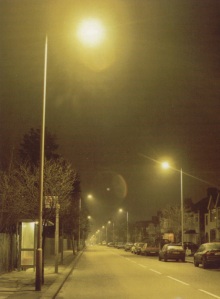
LightingpictureI’ve realized for some time now that I seem to possess an uncanny ability to extinguish streetlights. I’ll be walking along at night when the streetlight above my head suddenly blinks out. I can’t control this power consciously, and of course it doesn’t happen with every light I pass. But it does happen often enough to make me wonder whether I’m blessed, or cursed, with a form of telekinesis. There seems to be no good or bad use to be made of this power, but then again bending forks with mental energy isn’t about to save the world either.
Last night was a twin killing: two light-snuffings in a single half-hour walk. The first incident was ordinary enough: walking directly beneath the light fixture, the filament suddenly blows and goes dark. The second one, which happened about fifteen minutes later, traced a different arc. I was approaching the fixture, maybe thirty paces away, when the light went out — a more long-range influence than usual, but within acceptable tolerances for this sort of thing in my experience. As I passed directly under the lamp I looked up and noticed that the filament was still emitting just the slightest amount of yellowish-orange light. I walked on. About thirty paces past the streetlight I stopped, turned, and glanced back. In that instant, as I watched, the lamp switched to full-on brightness again. It was as if the lamp had been playing dead to trick me. I smiled in acknowledgment and headed for home.

Mea Culpa

I confess: I have violated my own self-proclaimed unforgivable sin. I revealed information obtained in private correspondence to a third party. Now I didn’t publish this information on my blog — if I had I’d have been forced to delete my own blog from my blogroll, which I suppose is kind of like dividing by zero. I don’t believe that the revelation was particularly consequential to the person who told me about it or to those toward whom the information points. Further, I have no way of knowing that the information I leaked is even true. And I thought at the time that the leak would be personally helpful to someone else.

Regardless of all these caveats, I fucked up. I acted hypocritically. I apologize for my lapse, and I’ll try not to do it again. As a self-imposed penance I will abstain from writing new blog posts for a week.

Appliance Attachment

For some reason — no, I believe I know the reason — I found myself thinking about The Brave Little Toaster this morning. It’s a movie our daughter used to watch as a kid, about a group of home appliances stuck in an abandoned posthuman house, deserted by the former owners. Left to their own devices (so to speak), the appliances continue to keep the house tidy in the futile hope that some day the owners will return. Eventually they set out in a Quest to find “The Master” — the son of the homeowners, to whom these household objects formed a particularly strong attachment. The moral to the story: objects are subjectively destitute when not plugged into The Correlation with humans.

Here’s a clip. That’s the late Phil Hartman doing the Nicholson impression.

Wading Out of the Shallow End

“How vividly I remember the first moments of my vocation as a clown!”

– Michel Huellebecq, The Possibility of an Island, 2005

Because my grounding in philosophy is shallow, I’m subject to being blown by the shifting winds of philosophical popularity. When the winds die down, so does my enthusiasm. Is it just my limited attention span, or is the whole object-oriented thing starting to run out of gas? I’m not militantly dysphoric about it: it doesn’t piss me off sufficiently to debunk it, even if I had the skills to do so. Instead, it’s just starting to leave me cold. My sagging passion for the objects isn’t, I don’t believe, reducible to a waning attraction/repulsion exerted by the main practitioners — though I don’t deny that’s part of it. Also, I’ve not become a convert to eliminative materialism or antiphilosophy, in part because I don’t really know enough about these alternative visions of speculative realism or have enough depth to evaluate them critically.

I think it’s my respect for depth that’s dampening my enthusiasm.

The object-oriented approach has introduced me to ontological and metaphysical topics about which there is a long history of speculation and critique. I’d never been strongly attracted to these investigations before: why now? Partly it was the blogging buzz: the flurry of posts and counter-posts, the personalities, the alliances, the feuds. These psychosocial impetuses have about run their course, at least for me. Do I have what it takes intellectually to dig a deeper foundation? Do I have the desire? The commitment? The sense of calling?

When I started paying attention to the speculative realism discussions they struck me as good material for fiction. One theorist projects himself into an arche-world before the evolution of humanity; another theorist goes the other direction, into a world from which man has fallen extinct; a third imagines a world populated by autonomous objects bumping into each other. Then there are the accelerationists and the singularity enthusiasts and the anti-speciesists and the apocalyptists, who appear from time to time on the periphery of my attention. It wasn’t the ideas of these people that captivated me but the posthuman metaphyical scenarios they conjured, with their resolute realism veering into otherworldly weirdness.

I just finished reading Michel Houellebecq’s The Possibility of an Island. Clearly he’s been captivated by these ontological speculations:

“Their aim, of course, was first to do away with money and sex, two pernicious factors of which they had been able to recognize the importance through the collective human life stories. It was equally a question of casting aside any notion of political choice, the source, they write, of ‘false but violent’ passions. These preconditions for a negative order, indispensable as they were, were not, however, sufficient in their eyes to enable neohumanity to rejoin ‘the obvious neutrality of the real,’ to use their frequently cited expression; it was also necessary to provide a concrete catalog of positive prescriptions. Individual behavior, they note in Prolegomena to the Construction of the Central City (significantly, the first neohuman work not to have a named author), was to become ‘as predictable as the functioning of a refrigerator.’ Indeed, while writing down their instructions, they acknowledged as a main source of stylistic inspiration, indeed more than any other human literary production, ‘the manual for electrical appliances of medium size and complexity, in particular the video player JVC HR-DV 3S/MS.’” (pp. 312-313)

The ontological speculation worked for him too, at least to an extent: he’s able, by the end of the book, to bring the prehuman and the posthuman, the raw biological instincts and the sheer technological efficiency, into stark contrast. He’s a novelist: he doesn’t have to choose sides in the philosophical debates; he can run thought experiments and see where they lead, letting the ambivalence run its course. And he doesn’t have to be a full-on philosopher to do it either. But he does have to be a full-on fiction writer. He had to devote himself to writing that novel, immersing himself in that fictional world long enough to bring something coherent and compelling out with him. As I said, to an extent he succeeded.  And he did remind me of something in the way he treated these ideas. Or maybe he reminded me of someone. Is being a novelist no different from being a clown, a shallow and cheap entertainer who jumps haphazardly from one schtick to another? Is it possible to regard clowning as a vocation?

Nuclear physics and astrophysics and evolutionary biology captivate me from time to time, but I know I’ll never sustain enough passion, enough intellectual commitment, to become a pro. It’s the same with philosophy for me: stimulating, challenging, even captivating for awhile, but then it drifts into the background, its call on my attention receding into background noise.

Right now it’s the noise itself that I hear. When it recedes like that, noise becomes nearly indistinguishable from silence. If I listen carefully enough, or maybe if I stop listening too carefully, something distinct will begin to emerge. Hopefully.

Civility

I’m finished with discussing people’s personal shortcomings on this blog. I’d sworn off it long ago but then, for what may have been good reasons or bad, I encouraged and jumped back into the return of the repressed rage. Maybe it really was a good idea at the time, served some useful function. But I’m done with that now.

I don’t deny the rage. If someone wants to talk about what an asshole someone is, or what an asshole I am for that matter, send me an email (portalic@gmail.com). I’ll be happy to listen, to gossip, to commiserate, to argue, to offer my opinion, maybe even to lend personal support for whatever that’s worth. I’ll probably even agree with you, inasmuch as these days I find myself routinely disappointed by and pissed off at practically everyone. But I’m done with the public airing of private grievances here, regardless of how justified or who started it. You say I’m standing in the way of freedom of speech, that I’m repressing the expression of the unconscious, that I’m schizzing the flows of creativity? Yes, I’m aware of that.

Disagreement, debate, argumentation? Not always my favorite sort of discussion, but it’s got a legitimate and honorable place in public discourse. And I’m still prepared to discuss publicly, and to write posts about, and to renounce, the dressing-up of private interpersonal disputes in abstract theoretical terms. But Dejan is right: there’s a lot of free-floating malevolence sluicing through the blogs. Civility might be a poor substitute for genuine love, but I prefer it to the direct or indirect public expression of genuine hatred, no matter how heartfelt.

The Reality of Blogging Identities

Recently there’s been some discussion, here and elsewhere, about whether fictional characters are real. Here’s a related question: are fictional blogging identities real?

In a heated exchange on another blog, the host “outed” a commenter as “really” being someone else with whom he’s previously engaged in at-times acrimonious discussions. Ah, the heck with it: Levi Bryant on Larval Subjects inferred correctly from his blog’s telemetry data that “A. Tuffini Denouferchie” is actually the same person as “Alexei.” Levi then chastizes Alexei and other commenters for not using their real names on the discussion threads, hiding in bad faith behind pseudonyms in order to write disingenuous and inflammatory comments without their snarky or trollish attitudes redounding negatively to their real reputations.

I acknowledge that I share Levi’s frustration with not knowing who’s on the other end of a blogging exchange. Though formerly I signed my comments as “Ktismatics,” right from the beginning I’ve always identified myself by my real name on this blog. As a consequence I suspect that I’m somewhat more cautious, more civil, in my blogging interactions than if I adopted a fictional blogging identity. In a sense one could say that, by posting as who I “really” am, I’m actually distorting the “real” me.

People choose fictional blogging identities for a variety of reasons. Some do it to hide themselves; others, to reveal themselves. Some probably adopt fictional blogging personae in order to “try on” different identities, voices, and attitudes. I have no problem with any of these reasons. “Tuffini” deploys a writing style and philosophical point of view that’s quite different from “Alexei.” Was Alexei wearing the Tuffini disguise in order to trick Levi, to blindside him, to hide like a coward while taking potshots at Levi? I have no idea, but I wouldn’t assume so. Fellow bloggers are always curious when a distinctive new commenter arrives on the scene. Last week I received an email from someone who tried to guess — incorrectly as it turned out — Tuffini’s “real” identity. The unmasking brings with it a kind of sadness, a loss of the sense of intrigue and possibility, a sense also that the unveiled person has been publicly disgraced.

But even if Tuffini really is Alexei, who is Alexei really? I don’t believe it’s his real name. Maybe the continental philosopher who is Alexei is no more — and no less — “real” than the analytic philosopher who is Tuffini.

I’ve written fiction under my own name, but I know others who write under a pseudonym. Are they cowards, hiding behind a false front so they can write zombie porn without their business colleagues knowing anything about  it? Did Stephen King know all the real reasons he began publishing as Richard Bachman? I didn’t self-consciously present myself as John Doyle on the blogs as some sort of authenticity gambit. I’d never even read more than a handful of blog posts before I started my own blog, so I had no idea that people tended to create semi-fictional identities for themselves. Also, I launched the blog as part of a PR campaign which I hoped would make the ideas I’d recently written in a book more visible, thereby enhancing my chances of scoring a publishing contract (didn’t work btw).

In an object-oriented ontology, any difference makes a difference. A fictional character is different from other fictional characters; real things are written about her on the page; readers think real thoughts about her. Thus the fictional character is arguably “real” even though she isn’t a real person, even though she is in fact an artifact of the author’s, and the readers’, imaginations. In my view, it’s OOO-consistent to regard Tuffini as real separate from his identity as Alexei, just as Alexei is real separate from the name and persona he goes by in his (or her?) off-line “real” life.

Writing under my own name does potentially expose me to real-life consequences I might not otherwise face. Does this give me the moral high ground? I don’t believe so. Again, I became John Doyle on the blog in part as a self-promotional device, so I have to live with the consequences if not all the publicity reflects well on my cleverness or my character. Still, I do share a kind of camaraderie with others who post under their real names. And I always do feel that my exchanges with pseudonymous bloggers are always somewhat more fictional, more artificial, than with those who go by their real names, even if I don’t know these people in any context other than the blogs.

Do I regard it as my ethical obligation to “out” the pseudonymous bloggers? Quite the opposite: I feel that I should respect the other person’s secret identity, regardless of the reason s/he has put on the disguise. What about when the pseudonymous blogger starts taking potshots at me? Certainly it’s a form of retaliation to reveal something about an enemy that the enemy would rather keep secret. But I don’t think one can claim the moral high ground to expose the other person, unless it so happens that the person is performing criminal acts, in which case exposing him/her is a civic duty even if that person is your friend and ally. Obviously we’re not talking about that situation.

Now, how about publishing information in private emails written by pseudonymous bloggers? My first instinct is to say “no harm, no foul” — no adverse consequences can accrue to a person’s real-world life by exposing private correspondences of his/her fictionalized persona. But when it’s the fictionalized persona whom we in the blogging world encounter, then I think that persona deserves to maintain the private/public distinction. The blogosphere is a social reality in its own right, and the characters who populate it merit respect being extended to them within the bounds of that reality. By the same token, I don’t regard pseudonymy as cart-blanche authorization for the semi-fictionalized blogger to dissociate him-/herself from ordinary civility developed within the “real” social world.

Both of these last two points are, I admit, controversial. Maybe I’m just old-fashioned. The blogosphere is a semi-fictional social reality: isn’t it legitimate to experiment with variants on ordinary-world civility in these semi-fictional social exchanges?